LVDTs are durable, accurate and very flexible. However, in certain situations, a standard installation won’t survive long due to harsh environmental conditions. Threats such as water, high pressure, extreme heat will cause the system to fail. But we have some good news, failure can be prevented with a relatively simple accommodation: isolation tubes. Let’s look at them, and explore some applications where they are required.
How Does an Isolation Tube Work?
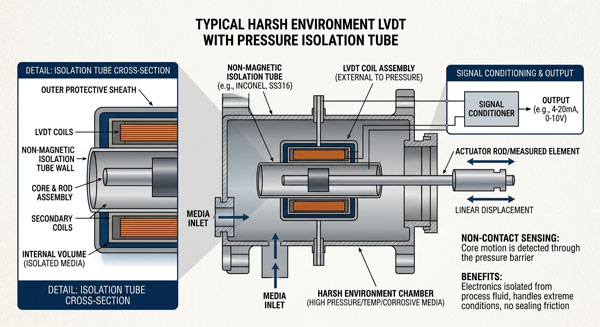
It’s a relatively simple principle. In a typical tube setup, the LVDT core assembly functions inside a sealed tube, while the LVDT’s housing slides over the outside of the tube. The LVDT’s magnetic field passes through the tube’s wall, which triggers the windings as normal. The tube simply acts as a shield that protects the sensing mechanism from the threatening external environment.
Applications for Isolation Tubes
Isolation tubes are used with LVDTs for many industries and applications. These include:
- Hydraulic Systems – these systems contain pressurized fluid in servos and other components that need to be measured. Examples range from industrial servo valves to more demanding ones such as rocket launch platforms.
- Downhole Drilling – Here, sensors are likely to be exposed to extreme pressure, temperature, and aggressive fluids at the same time. This makes them ideal candidates for isolation tube configurations.
- Submerged Installations – this is a more general category that covers anything that’s submersed in liquid such as water or corrosive chemicals. The reason for a tube installation is rather obvious: if an LVDT is submerged, it’s only a matter of time before the fluid gets into the housing and shorts it. With an isolation tube setup, the LVDT is completely protected from the liquid.
Tube Design Considerations
Remember, the tube is the only thing protecting the LVDT’s mechanics, so it must be built to survive in the unforgiving environment where it will be used. Dimensional and material considerations are the keys to getting it right.
One critical factor is that the isolation tube itself must be non-magnetic. There are a few metal options available, and the ideal one depends on the operating conditions. Stainless steel 316L is austenitic (non-magnetic) and is low in carbon and contains molybdenum, which adds corrosion resistance. 316L is the go-to choice for industrial and freshwater applications.
More demanding environments such as high pressure oil and gas, subsea, or deep drilling will also require higher tensile strength, high temperature resistance, and corrosion/pitting protection. For these situations, Inconel 625 or 718 may be used. Inconel 625 has 2-3 times tensile strength of 316L. It also maintains strength at higher temperatures and offers excellent corrosion resistance. This makes Inconel 625 ideal for subsea and chemical exposure applications. Inconel 718 offers significantly higher tensile strength, but lower corrosion resistance. It performs best in aerospace and high pressure applications.
For highly acidic or caustic environments, Hastelloy is the material of choice due to its exceptional resistance to oxidizing and reducing acids.
In addition to material selection, the other key factors are proper wall thickness and inner diameter. If the wall is too thin, it will eventually deteriorate or collapse. However, the wall can’t be too thick, as this will alter the magnetic field passing through it. This will negatively affect the LVDTs accuracy. Inner diameter is important since the LVDT’s components must be able to move freely. Wall thicknesses and diameters can engineering challenges since they need to strike the balance between strength and system reliability.
LVDT Alternatives for Tube-Based Installations
There are a few alternatives to LVDTs in tube-based position measurement solutions. These include:
- Hall Effect Sensors – these can go outside the isolation tube without going around it. They are good for long strokes where continuous exact precision data isn’t required. Hall effect sensors are generally less expensive than LVDTs, but this comes at the expense of accuracy. While they are also rugged, they should not be used where tight tolerance continuous measurement is required.
- Magnetostrictive Sensors – these will mount alongside or on the tube rather than over it, thus changing the geometry of the installation. The biggest advantage is that they provide the highest accuracy over long strokes. They can also be more sensitive to shock and vibration. They are more expensive than Hall Effect and LVDT sensors. Magnetostrictive sensors are overkill for shorter strokes since an LVDT is more accurate, cost effective and rugged.
Conclusion
If your application requires an LVDT to be submerged or subject to high temperatures or caustic chemicals, isolation tubes are a proven solution. Remember that the tube itself is only as good as its design, so you must get this right. The tube must hold up on harsh conditions so the LVDT can reliably provide constant, accurate position data.